MATHEMATICS RESEARCH
1 .- flat-known figures:
a) Square:

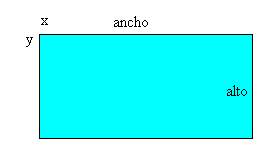
The square is a polygon with four sides, with the peculiarity that they are all equal. Besides its four corners are 90 degrees each.


2 .- perimeters of plane figures:
a) Square

Perimeter = 4a

Perimeter = 2 (a + b)

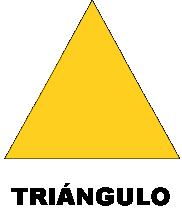
Perimeter = a + b + c
Perimeter = 2 (a + b)
Perimeter = 2 (a + b)

Perimeter = 2 (a + b)
perimeter: it means

Perimeter = 5 (a)
-

Perimeter = 6 (a)
-
a) Square:

Area of \u200b\u200bsquare = side squared

Area of \u200b\u200brectangle = base.altura

Area of \u200b\u200btriangle = (base. Height) / 2

trapeze Area = [(base + base increased less) . height] / 2

diamond Area = (diagonal mayor.diagonal lower) / 2

base.altura Area of \u200b\u200bparallelogram =

Area of \u200b\u200bcircle = 3.14.
radius squared 
Pentagon Area = (perímetro.apotema) / 2

Area hex = (perímetro.apotema) / 2
4.-Polyhedra and Geometric Solids:
- Faces: The faces are external parts of a given solid. Ex: The faces of the Egyptian pyramids are 4.

-
- Arista: is any line segment where two planes intersect. Ex: The faces that converge on the same edge of the pyramids of Egypt.

- Vertex: The apex is the point of convergence between two or more line segments. Ex: The apex of the pyramid of Cheops reached 146.59 meters above sea level.

regular polyhedra are called all those who all their faces are formed by equal regular polygons, which are interconnected polyhedra equal angles. Classes:

-
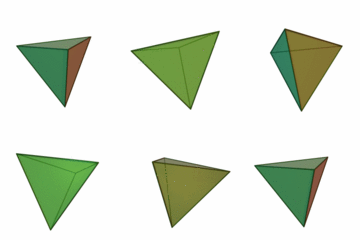
a) regular tetrahedron :
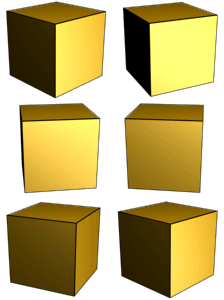
b) regular hexahedron or cube:
c) regular octahedron:

d) regular dodecahedron:

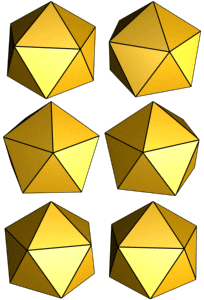
e) regular Icosahedron
-
a) Prisms:
-Concept:
-
Volume = (Area of \u200b\u200bBase ) * (Distance between bases )
- Prisma oblique: An oblique prism is a prism whose lateral edges are oblique to the bases

- Roof prism: is classified as having two congruent sides in parallel planes and the sides are rectangles. The height is the distance between parallel faces.

- regular Prisma: This solid is limited by two regular polygons which are known as base and as many rectangles as sides have base.

b) parallelepiped:
-Concept:
-
Is usually two horizontal faces (which are the upper and lower bases, or floor and ceiling) rectangular, with four sides (flat walls) vertical, parallel and perpendicular to the bases.
-
Rating:
-
- straight parallelepiped: If its lateral edges are perpendicular to the bases. The faces are rectangular regions

-
- Rectangular parallelepiped : ste E parallelepiped has the Following features where all sides are rectangular regions. It is also called a cuboid or rectoedro . When all the edges are congruent, called cube or regular hexahedron.

- rectoedro:
- cuboid: The cuboid is a rectangular parallelepiped basic right.

- Cube or hexahedron regular : A hexahedron is a six-sided polyhedron called a cube, all sides are equal.

- Rhombohedral: parallelepiped is all that is rhombohedral bases or regions of a polygon-shaped diamond.

6 .- base area, lateral area, total area, volume of prisms and parallelepipeds.
Tataedro:
base area: anywhere in this polyhedron can be the basis:
Base x height / 2
lateral area: any face in this polyhedron can be a side face:
Base x height / 2
Total Area:

Volume:

-
regular hexahedron:
Base Area:
depends on the square or pentagon, depending on their shape.
lateral area:
4 x squared edge.
Total area:

Volume:
V = a3
-
regular octahedron:
Base Area:
Base x height / 2
Total area:

Volume:

-
regular Dodecaedo:
Total Area:

Volume:
-
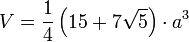
Icosahedron:
Volume:

Pyramid:
Concept:
The pyramid is any solid figure formed by triangles as sides, which join at the same vertex. Also one of their faces is a polygon anyone who is called the base.

Formulas to find the:
Area base: Base x Height
lateral area: is the total of all areas of the sides.
Total area: is total between the lateral area between the base area.
Volume: is by multiplying area and squared by height, all three.
References:
http://es.wikipedia.org/wiki/Piramide_ (geometri-a)
Elements of the pyramid:
Faces : The faces of the pyramids are the external parts of said parallelepiped, with additional feature that the number of faces is equal to the sides of the base of the pyramid.
Sides: The sides of the base of the pyramid are called basic edges.
Base: The base plays an important role in the name of the pyramid, and on the number of sides that has


-
types of pyramids:
- regular pyramid: got its name when the base is a regular polygon as well all lateral edges are congruent, that is of equal length. From this definition we deduce that all faces of a regular pyramid are congruent isosceles triangles and the height falls in the center of the base.

- triangular pyramid: this triangle has the properties that the base has the shape of an equilateral triangle, and their faces side of an isosceles triangle.

.-
- The Tetrahedron: is a pyramid formed by four equilateral triangles. Any face, therefore, may be the base. Also as a solid geometric figure.
References:
http://www.educared.cl/e5_volumen_piramide.htm
cylinder revolution
Concept: straight cylinder is also known as cilindor of revolution. Say yes to the cylinder is formed by a rectangle that rotates around one of its sides. The side opposite the rotation axis is the generating and generates the lateral surface of the cylinder, the sides perpendicular to the axis of rotation generated by the basic circles.

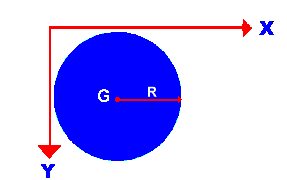
- base area: The formula used to determine the area of \u200b\u200bthe base of a cylinder is a circle, as their bases are circular. Its formula is:

- lateral area:
| If we call L to the length of the generatrix and R is the radius of the base, the lateral area be. A = 2 (3.14) (r) (l) | |
 | |
- Total area: To determine the total area of \u200b\u200ba cylinder of revolution. We have to find your area lateral and basal area and added these areas gives us the total area of \u200b\u200bthe cylinder which is called: The total area.
-
- Volume: The opposite to the rotation axis is the generating and generates the lateral surface of the cylinder, the sides perpendicular to the axis of turn generate basic circles.

-
Cone of revolution:
- concept: Called cone of revolution or simply cone, a portion of space bounded by a conical surface of revolution and a plane perpendicular to the axis.

base area: The cone has a single base and has a rectangular shape, it can also determine your area of \u200b\u200bthe base is by formula to find the area of \u200b\u200ba circle like a cylinder. The difference being that the cylinder is 2 bases.
Àrea lateral : The lateral area of \u200b\u200ba cone of revolution : Height. radio. generating
Sl = 3.14 (r) xh
base area, lateral area, total area and volume of a cylinder of revolution
Cone of revolution : concept
base area, lateral area, total area and volume of the cone of revolution
Sphere: concept
area and volume of the sphere.
Exercises and problems of implementation problems where measures are determined using the clearance unknown variables in a formula.
Pythagorean Theorem.
Pagina de problemas:

